
Friday, Nov. 6, 2026No. 43Morning editionNumbers through Thu, Nov. 5Hot StoveFirst spring game in 105 days
13 finals around the world5-min readPress time 17:51 CETHeadlines: 1/20 feeds failed
In this editionMexican Pacific LeagueTonightAround the WorldStat Lab FundamentalsInsideLast Nightp. 2Stat Labp. 3Around the Webp. 4
The Whiff
Six at-bats from a dramatic game, one at a time. Make your call before each one plays out.
Play before you read on: the pages below can give the score away.
Mexican Pacific League
Navojoa 7, Obregon 8 (LMP, 11, walk-off)
Navojoa 7, Obregon 8 (LMP, 11, walk-off). Stat Lab Fundamentals: The force out and the tag.
- 6.78 Drama Index, Game of the Night
- 13 finals around the world
- Countdown: first spring game Fri, Feb. 19 (in 105 days) · Opening Day Thu, March 25
- Stat Lab Fundamentals #3: The force out and the tag
Tonight
Hermosillo at Guasave
- League Mexican Pacific League
- First pitch Sat 03:30 CET
- Hermosillo 45%
- Guasave 55%
- Bravos at Leones · 21:00 CET · Leones 54%
- Leones at Gigantes · Sat 00:00 CET · Leones 54%
- Tigres at Tiburones · Sat 00:00 CET · Tiburones 52%
- Navegantes at Aguilas · Sat 00:00 CET · Aguilas 50%
Around the World
- LVBP: Navegantes 6, Aguilas 5 ★★★★ · Tiburones 4, Tigres 3 ★★★★
- LMP: Mazatlan 3, Mexicali 0 (shutout) ★★★ · Los Mochis 3, Nayarit 6 ★★ · Guasave 1, Jalisco 4 ★★ · Culiacan 2, Hermosillo 7 ★
- LBPRC: Caguas 1, San Juan 4 ★★★ · Carolina 5, Mayaguez 2 ★★ · Santurce 0, Ponce 5 (shutout) ★★
- AFL: Rafters 3, Javelinas 5 ★★★★ · Solar Sox 6, Desert Dogs 3 ★★ · Scorpions 1, Saguaros 9 ★★
| Team | W | L | Pct | GB |
|---|---|---|---|---|
| Caribes | 15 | 5 | .750 | – |
| Cardenales | 11 | 6 | .647 | 2.5 |
| Tigres | 11 | 8 | .579 | 3.5 |
| Bravos | 10 | 9 | .526 | 4.5 |
| Leones | 8 | 10 | .444 | 6.0 |
| Tiburones | 9 | 12 | .429 | 6.5 |
| Navegantes | 8 | 13 | .381 | 7.5 |
| Aguilas | 6 | 15 | .286 | 9.5 |
| Team | W | L | Pct | GB |
|---|---|---|---|---|
| Guasave | 15 | 5 | .750 | – |
| Mexicali | 12 | 8 | .600 | 3.0 |
| Hermosillo | 11 | 8 | .579 | 3.5 |
| Culiacan | 11 | 9 | .550 | 4.0 |
| Jalisco | 11 | 9 | .550 | 4.0 |
| Obregon | 10 | 10 | .500 | 5.0 |
| Mazatlan | 9 | 11 | .450 | 6.0 |
| Los Mochis | 7 | 12 | .368 | 7.5 |
| Nayarit | 7 | 13 | .350 | 8.0 |
| Navojoa | 6 | 14 | .300 | 9.0 |
| Team | W | L | Pct | GB |
|---|---|---|---|---|
| Carolina | 2 | 0 | 1.000 | – |
| San Juan | 1 | 0 | 1.000 | 0.5 |
| Santurce | 1 | 1 | .500 | 1.0 |
| Ponce | 1 | 1 | .500 | 1.0 |
| Caguas | 0 | 1 | .000 | 1.5 |
| Mayaguez | 0 | 2 | .000 | 2.0 |
The Daily Whiff · Friday, Nov. 6, 2026 Page 2
Last Night
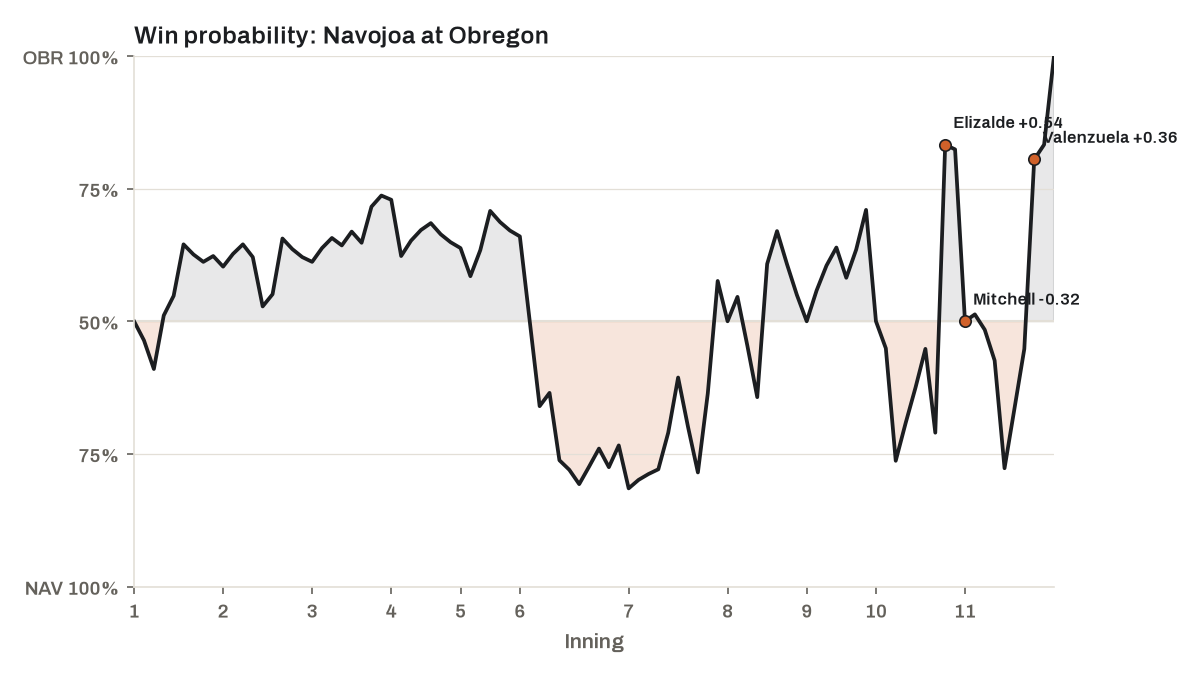
Game of the Night: Navojoa 7, Obregon 8 (LMP, 11, walk-off)
- Drama Index 6.78 ★★★★★ · 2 lead changes · Obregon came back from 2 down · 11 innings · peak leverage 5.65 (top 11th)
- Top WPA: Sebastián Elizalde +0.65 (batter) · Roberto Valenzuela +0.50 (batter) · Alejandro Quezada +0.20 (batter)
- Bottom WPA: Cristian Alvarado -0.42 (pitcher) · Cal Mitchell -0.36 (batter) · Marco Vargas -0.24 (batter)
Watch: Gameday (MLB.com)
| Inning | Matchup | Result | Win probability | WPA | LI |
|---|---|---|---|---|---|
| Bot 10th | Sebastián Elizalde vs. Gerardo Lopez | Single | OBR 29% → 83% | +0.54 | 5.22 |
| Bot 11th | Roberto Valenzuela vs. Luis Valdez | Double | OBR 45% → 80% | +0.36 | 4.40 |
| Bot 10th | Cal Mitchell vs. Luis Valdez | Grounded Into DP | OBR 82% → 50% | -0.32 | 5.29 |
The Daily Whiff · Friday, Nov. 6, 2026 Page 3
Stat Lab
Stat Lab Fundamentals · Lesson 3: The force out and the tag
Of Pete Crow-Armstrong’s 175 hits in 2026, 45 were home runs, and a home run over the fence is the one hit that leaves the defense no play. On the rest the defense had a play to choose, and the choice depended on one question: was the runner forced to go?
The idea. Most outs on the bases come one of two ways. On a force out the runner has to move up because the batter, or the runner behind him, is taking his base, and the defense only needs the ball and a touch of the base before he gets there. On a tag he is not forced, so a fielder must touch him with the ball while he is off a base. The batter has to run on every ball put in play, and a runner is forced only while every base behind him is taken.
The math. Count the players who have to advance: the batter, plus the runners in an unbroken chain from first base. Bases empty: 1, the batter alone. A runner on second alone: still 1, because first base is open. A runner on first: 2. Runners on first and second: 3. Bases loaded: 4, and one of them is the runner from third, forced to run home, so the catcher can make a force out at the plate. Back to Pete Crow-Armstrong: 175 hits less 45 home runs leaves 130 other hits, all of them in play.
The scale. Force outs are the easiest outs on the field, so most double plays run through them: a ground ball, a force at second, a throw to first. A tag takes more: the fielder must catch the throw and still bring the glove down on a moving runner.
What it doesn’t tell you:
- A force lasts only while every base behind the runner is still taken; once the runner behind him is out, a fielder must tag him.
- A runner is safe only while he touches a base: slide past second or third and he can be tagged out. He may run through first base and past home plate.
- Not every out on the bases is a force or a tag: a runner who left his base before a fly ball was caught can be doubled off by a throw to that base.
- A tag needs the ball: an empty glove, with the ball in the other hand, is not a tag.
Try it. Next time a ground ball is hit with a runner on first, decide whether he is forced, then watch what the fielder does.
Go deeper: MLB Glossary: force play · MLB Glossary: double play · MLB Glossary: out
Check yourself
- Q1. A runner is on second base alone and the batter hits a ground ball. Is the runner forced to go to third?
- Q2. With the bases loaded and a ground ball in play, how many players have to advance?
- Q3. What is the difference between a force out and a tag?
Show answers
- A1. No. First base is empty, so only the batter has to run. A throw to third would need a tag.
- A2. Four: the batter and the three runners. That is why a catcher can step on home plate for a force out.
- A3. On a force the fielder only has to touch the base with the ball before the runner arrives. On a tag he has to touch the runner with the ball.
The Daily Whiff · Friday, Nov. 6, 2026 Page 4
Around the Web
News
- MLB lockout tracker: What CBA talks mean for Phillies baseball — Yahoo Sports
- Manitoba Baseball HOF announces 2027 class — Canadian Baseball Network
- Phillies Don Mattingly, Cristopher Sanchez, Jhoan Duran finalists for top awards — Yahoo Sports
- McFarland: Versatile Borthwick named Baseball Sask’s Female Player of the Year — Canadian Baseball Network
Transactions & Rumors
- Poll: Will Jake Bauers Accept The Qualifying Offer? — MLB Trade Rumors
- Tarik Skubal Rumors: Mets, Dodgers, Cubs — MLB Trade Rumors
Analysis · Prospects · Listen (5)
Analysis
- Top Landing Spots for Free Agent Seiya Suzuki — Just Baseball
- 2026-2027 Free Agent Predictions: Landing Spots and Contracts — Just Baseball
- Cup of Coffee: November 5, 2026 — Cup of Coffee (subscription)
Prospects
- 2026 Los Angeles Dodgers Org Prospect Team — Prospects Live
Listen
- To the Show Podcast: An Interview with Braves Prospect Daniel Brooks — Prospects Live Podcast · 27 min
Terms in this edition
Drama Index: Our own measure of how much a game kept both sides guessing: the total of every swing in win probability over the game, divided by 100. A game that one team controls from the first inning scores low; a game full of lead changes and late swings scores high.
Leverage Index (LI): How much the next plate appearance can swing win probability, compared with an average plate appearance. 1.0 is average; 2.0 means twice the usual stakes.
Win Probability Added (WPA): How much one play changed a team’s chance of winning. The batter is credited with the change and the pitcher is charged the same amount with the opposite sign; add up a player’s plays and you get his WPA for a game or a season.
Force Out: An out on a runner who has to advance because the batter, or the runner behind him, is taking his base. The fielder only needs the ball and a touch of the base before the runner gets there; no tag is needed.
Tag Out: An out made by touching a runner with the ball while he is off his base. The ball can be in the fielder’s bare hand or in the glove he touches the runner with.
Sources & Notes
Built automatically from MLB Stats API data; numbers through Nov. 5, 2026, with FIP, xFIP, WAR and wRC+ up to a day behind. How this site works